Notaries House

Notaries House is an important building from both a historical and architectural perspective. Built on the foundations of a Roman fort, the property dates back at least to the early 1400s (including one of our practice rooms, seen to the left of the main building). However much of the original fabric burnt down in the late 1600s and the large four-storey building was built, then one of the largest in Exeter. Most of its internal fittings survive from this period:
“with its fine staircase, panelling, fireplaces and other fittings, the Notaries’ House must rank as one of the best-preserved examples of grand town housing of this period in the city”.
For more detail read Wolfspaw’s blog
To find us
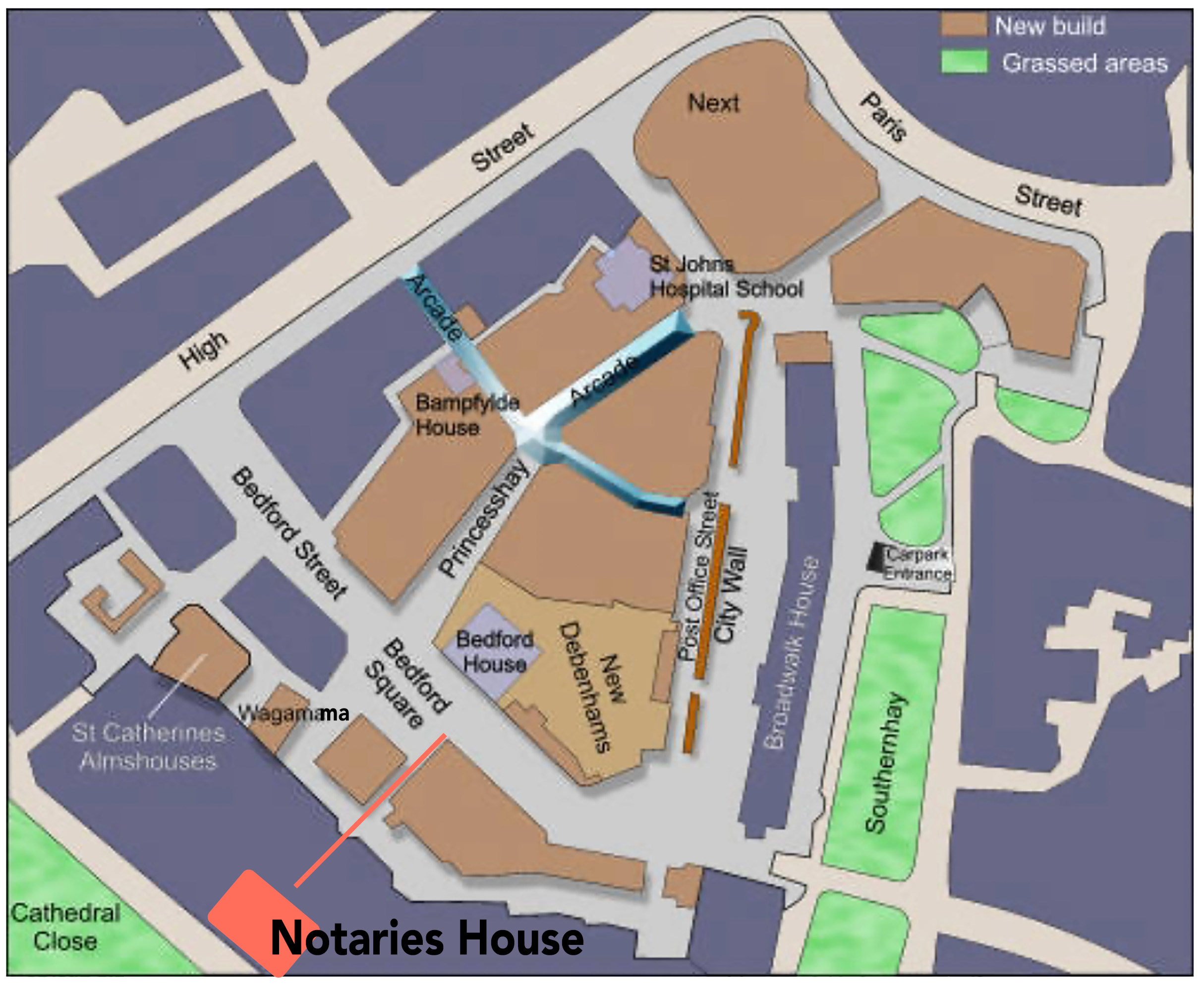
Find the Princesshay shopping precinct in central Exeter. Aim for the open space closest to the Cathedral (Bedford Square). Look for the (closed) Cafe Rouge restaurant: from outside its former entrance you can see Notaries House in front of the Cathedral through a gap in the buildings. Walk down the steps and you are there.
If you cannot use the steps take a detour to the left as you face the Cathedral and you will be able to take the service road. Disabled parking is available by prior arrangement.
DO NOT USE GOOGLE MAPS – this will take you to the Cathedral Close on the wrong side of the building!
Call 01392 213 899 if you get lost.
Notaries House is home to the Sustainable Health Centre
Read more about it here
Disclaimer.
Each person and illness is unique and, unlike a personal health consultation, no publication can anticipate every circumstance or be appropriate for every reader. Knowledge and best practice in the health field are also constantly changing. The information in Plant Guides and the links to other sites is selected for its suitability for self care reflecting the best evidence available. However it can never replace a personal diagnosis nor substitute for a prescription. Many apparently unremarkable symptoms may disguise something more serious. If a problem has been longstanding or is otherwise inexplicable or alarming, it is important to consult professional health advisors or registered medical practitioners who are better able to spot problems that need further treatment.
In obtaining herbal products, users should not assume that all products are of good quality and should read the label carefully for detailed information about safe use, and should choose responsible manufacturers with independently assured quality standards and safety monitoring procedures. The herbs chosen in Plant Guides have good safety profiles and the best available advice is that they should generate no significant adverse effects if of good quality. However idiosyncratic reactions can occur to almost any consumed substance and although very rare can never be ruled out. Even these are most unlikely to have lasting effects if advice on this site is observed and the remedy stopped immediately.
The information provided in Plant Guides is not a direction to any individual treatment or herbal product, and to the fullest extent of the law, neither the publisher nor the authors, contributors or editors, assume any liability for any injury and/or damage to persons or property as a matter of products liability, negligence or otherwise, or from any use or operation of any methods, products, instructions or ideas contained in the materials.